



Is a lack of curiosity killing travel?

What is it in so many of us that swaps curiosity out for an agenda?
The self-reinforcement of popularity, principally through social media and now AI, is extraordinary to watch. People see a backdrop on Instagram, so they travel there to capture the same backdrop, even with a mob scene behind the camera. Few seem interested in taking even a moment to appreciate the place itself. And AI is built on mass data — where there's more information, that's deemed the safer bet, so it gets flagged as the place to go. The cycle continues.
The type of travel that results is almost acquisitional. Transactional rather than interactive. Go here, capture photo, move on — rather than going somewhere to watch, listen, and absorb.
I recently got an email from an erstwhile colleague, now living up in the highlands of Scotland. It paints rather a lovely picture, so I'm going to drop it in here unabridged:
"I have just visited 'The Old Man of Stoer' in the north-west highlands of Scotland. It is a place of hidden coves and brightly coloured bogs that only the more adventurous travellers find. I have been out practising my navigational skills and stumbled across a steep stream bed which took me down one of the sea cliffs that are filled with pink sea drift blossoms and rose roots. The route took me to a deserted rocky shore, where I found a group of squawking oyster catcher birds on the hunt for lunch, stacks of ancient Lewisian gneiss and broken-down quartzite and sea pools brimming with life. There was no sign of people.
Anyway the reason I email is because as I skipped across the bog back to my car (overwhelmed with joy), I crossed the car park and noticed what most tourists here were doing. They had parked their fancy motor homes and Land Rovers, wandered to the lighthouse (a mere 500 metres away) and taken a few snaps. I might add that to arrive here is tough — a drive that takes commitment, miles of single trackwinding through crofting lands where sheep have taken over the roads and the risk of having to do a 1/2km reverse is very real. After getting their quick photos and peering at the sea for a second these tourists then promptly headed back to the shelter of their vehicle. It is windy but for Scotland the weather is welcoming today.
It made me think of Pura and all of the guides & hosts that you take such care choosing. The people who show travellers the real magic of the places they visit. This is a privilege but also the sole reason that I travel. To explore further than what Google maps photos shows of a place.
I just wanted to say it is a brilliant thing you're doing connecting people with places and I hope that many more people are able to experience this through the work of Pura."
It's nice to get the compliment, but it's not really about Pura. It's a much wider thing — it's about how many people travel. If you're looking, it's everywhere. Possibly blocked by a cruise ship or a selfie-stick, but it's there.
Why would I use a tour operator?
If you've never used a tour operator to arrange your travels, you're not alone. You always arrange your own trips — why wouldn't you? You know what you like and what's worked before. You go at your own pace,you do your own research. Between ChatGPT, Booking.com and Google, you've got this stuff covered. And you've got a nose for these things, so you can tell when something's too good to be true (and how to swerve the tourist traps).
Here's the thing though. The further we get from our home territory, the harder it is to use our intuition and fuzzy knowledge. We all know that no locals stay in Paris in August and all the good restaurants are shut. What's the equivalent in Buenos Aires? Lower volumes of information mean AI models, search engines and social media are simply less well informed.
Which means you don't really know what you're stepping into.
That's where a tour operator might just be the answer. Not just any tour operator, but a true specialist (yes, like us). Want to know what the roads through Chilean Patagonia are actually like? We've driven them, multiple times. Need a Brazilian fazenda where the welcome's as warm as the tropical breeze? We know just the place.
With us, you won't miss the tens of thousands of raptors flocking across the sky in Costa Rica because nobody mentioned their migration path runs 15 minutes from your lodge. You won't drive past an unassuming bodega in Rioja that actually produces some of the best wine in Spain. You won't follow the crowd simply because you didn't know where else to go.

A quick story about crowds
On a family holiday to Croatia recently, I was stunned by the beauty of the lakes and waterfalls of Plitvice National Park. So were lots of other people — nose to tail on raised wooden walkways, taking photos of themselves at viewpoints, seemingly never stopping to actually look at the view. All this despite the fact that waterfalls are precisely the visitor sites where we apparently feel overcrowding most acutely.
Then we got to a crossroads. One path led to a boat along the lake back to the start; the other continued along the lakeshore towards more waterfalls and lakes — and, ultimately, a boat back to the start. Each route was equally well marked and clearly signposted.
As soon as we took the lakeshore path, we were alone. Properly alone. Surrounded by the same incredible landscapes, but no longer shuffling nose to tail. We had time and space to breathe, to listen to the birdsong, to walk and talk.
Back at the crossroads, there was an enormous queue in the baking sun for that boat.
This isn't to say that everyone is able to, or interested in, doing the (marginally) longer loop. It is to say that surely a decent number could — which in turn would take the pressure off for those who can't.
Going beyond the obvious
Going beyond the obvious is absolutely central to our holidays. Torres del Paine & Beyond, Rio & Beyond, our new Salta to Mendoza journey — all of them are built around the idea that whilst it's incredible to see iconic places, it's ultimately far, far more rewarding to push on and discover there's much more than you imagined close at hand.
A quieter valley an hour beyond the famous viewpoint. A village nobody's made a TikTok about. A stretch of coast the tour buses don't go to.

Getting to those places takes a little planning (where we come in). It also takes a certain kind of traveller — one who's willing to keep going when the guidebook stops. What we try to do is give you the space to be curious. To follow the path to the picnic spot without a plan. To peel off your socks and paddle in a mountain stream because the water looks too inviting not to. To peek around the corner just to see what'sthere.
We won't fill every hour of every day, because the best moments almost never happen on schedule. But we will, quietly and carefully, point you towards the experiences you didn't know you were looking for.
This recent feedback from Costa Rica puts it rather well:
At almost every venue it felt like we weren't simply following the un-thinking tourist crowd, and that we were able to appreciate and participate with the local people and cultures we were among. From Tino's garden, to having lunch with Cesar's family. All tourism, of course, but paying back at a grass-roots level where it matters most, and has the best impact.

The idea belongs closer to home too. Whether we drive up and don't explore much beyond the car park, or don't quite take the time to find out what else might be nearby, beyond the Insta-ready-obvious — I think we owe it to ourselves to be curious.
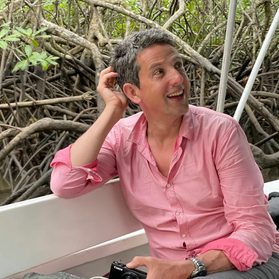
Thomas Power
Founder of Pura Aventura
Thomas has run a café in northern Mexico, lived on a Honduran island, guided tours in Spain, and worked for the UN in Santiago. He founded Pura Aventura in 1999 with a debt of gratitude for the beautiful landscapes and warm hospitality he encountered in Patagonia, hitchhiking the Carretera Austral years before. He was determined to share these places, however unknown they were at the time. Since then, he and the team have expanded the destinations offered, but have always stuck to their "inch-wide, mile-deep" approach: great holidays booked directly with local hosts, guides and owners, no intermediaries, just intimate expertise translated into trips designed to protect and benefit the places and people they send travellers to.


