



Patagonia: The great north-south divide
Patagonia's a place which can confuse, at least before you go there. Is it a country? Is it all the same? Where are the penguins? This is a non-comprehensive introduction to both halves of Patagonia, which will hopefully shed some light.
Putting Patagonia on the map
Firstly, it's not a country - it's a physical and even cultural region which covers the whole bottom end of South America. It's part Chile and part Argentina; it has no formal boundaries.

Firstly, it's not a country - it's a physical and even cultural region which covers the whole bottom end of South America. It's part Chile and part Argentina; it has no formal boundaries.
In Chile, they have a fairly strict definition of Patagonia - it's everything south of the city of Puerto Montt. So that's the island of Chiloé, the Carretera Austral and then a bunch of ice, Torres del Paine and south to Puerto Natales, Punta Arenas - onto Tierra del Fuego and the Magellan Straits.
In Argentina, Patagonia tends to evoke more romantic ideals of gauchos riding out across the plains; it appeals to the perhaps more flamboyant European influence of Italian migrants. Which is to say that, on the Argentine side of the border, Patagonia 'starts' way further north than it does in Chile.
Chile and Argentina are separated by the Andes - the border between the two countries is the line of the Andean peaks. If it melts and flows to the Atlantic, that's Argentina. If it flows to the Pacific, that's Chile. The land to the west of the Andes, Chile, is much more exposed to the Pacific and tends to be narrow, much more densely varied and featured than the eastern side. Chilean Patagonia is largely therefore seen as winding, impenetrable, steep, forested, glaciated with lakes and rivers and islands. The Argentine side falls away from the high mountain peaks to vast open plains as far as the Atlantic.


End of the Andes
Patagonia, as most people have seen it or know of it, is southern Patagonia. Torres del Paine on the Chilean side is probably the most famous single highlight here, but just across the border in Argentina is the Perito Moreno Glacier. North of that, you have the FitzRoy mountain range, one of the most iconic massifs in the world. Paine, Perito Moreno and FitzRoy are each about half a day's travel from the other - they're all the same ecosystem, a sort of full stop at the end of the Andes. The icefield that flows into Torres del Paine is the same icefield which forms Perito Moreno and all the other glaciers of the region.
The vast majority of Patagonia trips combine these three or at least two of the three. It's where the infrastructure is, the larger hotels and fancier lodges are, and where the visitor numbers are at their highest.

The Carretera Austral
There is another Patagonia, though. The north.
If you were to stand at Glacier Grey inside Torres del Paine with a jet pack on, take off and fly north, you'd travel over the Patagonian Icefield. Where the ice stops, you land, and you're standing at the end of Chile's southern highway. From this point north to Puerto Montt is a road called the Carretera Austral - a journey just shy of 1,000km. This is all still Patagonia, but it looks and behaves very differently to southern Patagonia.
First of all, there are vastly fewer visitors. Second of all, the variety is arguably greater - glaciation gives way to mountains, lakes, rivers and then temperate rainforest. On the Argentine side are mountains, canyons and deserts. It's all ridiculously beautiful, but more lived-in than the south.


Southern Patagonia was populated by force, with brutality, in the late 19th century by sheep farming interests - English, German, Latvian, Portuguese. These were industrial-scale enterprises rather than small-scale farms. The estancias they created were absolutely vast - tens of thousands of hectares. It also means that villages didn't really form. Harbor towns, yes, but those are very few and far between. What you see to this day are occasional cattle stations and very, very occasional towns. Fast forward through time, and the land in and around Torres del Paine isn't available to ordinary folk - it's simply packaged in units too large for all but the wealthiest of investors. Those are the people who've acquired land here and developed the infrastructure for tourism.
Given the scale of that investment, the hotels and lodges they build tend to be on a larger scale or at a more premium level. There's little in the way of dispersal of economic benefit from tourism - most people work in tourism in some capacity.

Meanwhile, in the north...the less accessible part of Patagonia on the Argentine side was far enough from the industrial farming interests to allow individual families to come and set up estancias. It's in this part of Argentina that the Welsh settlers came to protect their language and traditions in what was seen as an isolated bubble far from anywhere.
On the Chilean side of the border, there was only a narrow strip of land between the mountains and the Pacific. Always a risk that Argentina would seek to establish a foothold on the Pacific coast, this remote and very thin bit of Chile was always at risk. In the 1970s dictator Augusto Pinochet decided to use prisoner labor, hard labor, to create a road and along it a protective line of communities. Impossibly ambitious. Even today, there are large stretches which are unpaved and other stretches which aren't road at all but car ferries. To get more people living down there, the government allowed people to lay claim to several hectares of land, which they were given.
When tourism arrived here, about the same time Pura Aventura first started working in the area, the land available to buy and develop was in lots of one or two hectares. There were villages close enough that people staying in a small hotel or lodge could eat out nearby. There were communities from which guides and drivers and cleaners and cooks could come. In large part, the model of tourism which could emerge in northern Patagonia was much more dispersed, much smaller scale and with much more personality than could ever have been the case further south.

That's how come we have César, Verónica, Cristian, Noel, Tim, Maria Paz, Francisco and Nela all waiting to welcome you as you journey through northern Patagonia - both sides of the frontier. It's why the places you stay in northern Patagonia might have four, six, perhaps 10 rooms at most. The area gets perhaps 1% of the visitors of southern Patagonia but that's not because it's 1% of the experience. Nothing could be further from the truth.
So, north or south?
Both if you can. The scale and drama of the big hitters of southern Patagonia is impossible to match. But if you enjoy people and local flavors in landscapes which can stop you in your tracks, and you don't like to follow the herd, then northern Patagonia should be where you find your Patagonia.
Experience Patagonia with Pura Aventura...


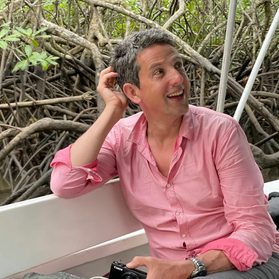
Thomas Power
Founder of Pura Aventura
Thomas has run a café in northern Mexico, lived on a Honduran island, guided tours in Spain, and worked for the UN in Santiago. He founded Pura Aventura in 1999 with a debt of gratitude for the beautiful landscapes and warm hospitality he encountered in Patagonia, hitchhiking the Carretera Austral years before. He was determined to share these places, however unknown they were at the time. Since then, he and the team have expanded the destinations offered, but have always stuck to their "inch-wide, mile-deep" approach: great vacations booked directly with local hosts, guides and owners, no intermediaries, just intimate expertise translated into trips designed to protect and benefit the places and people they send travelers to.


